%20No%20Text-02.png)
Copy of Parenting for Growing BrainsA Neuroaffirming Approach to Child Behavior, Emotional Regulation, and Connected Discipline

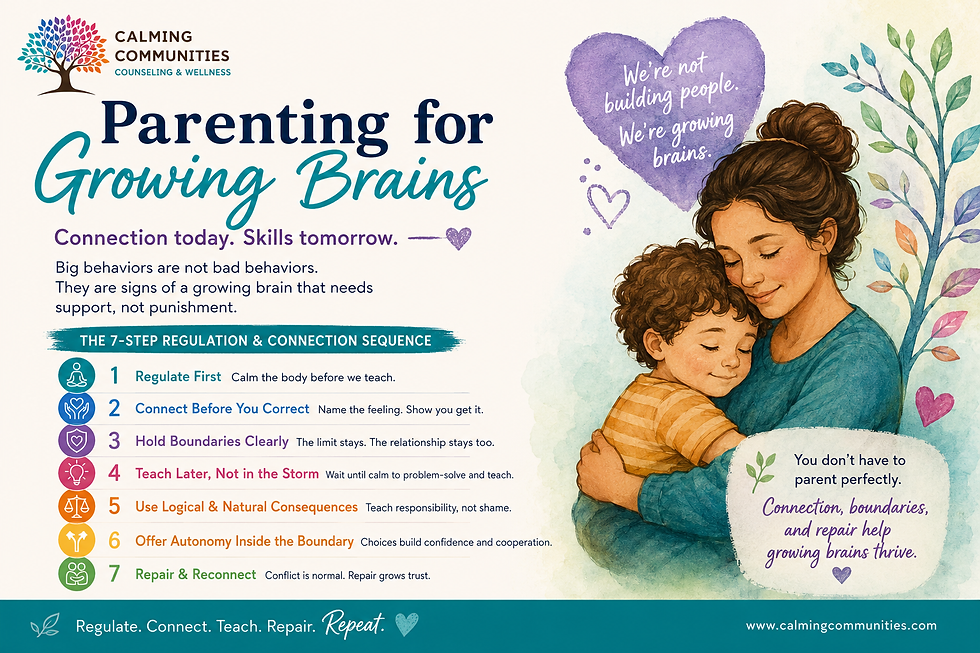
When children are struggling with meltdowns, aggression, anxiety, shutdowns, defiance, or “difficult behaviors,” many parents feel exhausted and overwhelmed.
You may have found yourself wondering:
“Why does nothing seem to work?”
“Why do consequences keep failing?”
“Am I being too soft?”
“How do I help my child listen without yelling?”
“Why does my child fall apart over small things?”
If this sounds familiar, you are not alone.
At Calming Communities Counseling & Wellness, we want parents to know something important:
Big behaviors are not usually signs of a “bad child.”They are often signs of a growing brain struggling with stress, overwhelm, emotional regulation, sensory needs, or unmet support needs.
Children are not miniature adults. Their brains are still developing the skills needed for:
impulse control,
flexible thinking,
frustration tolerance,
communication,
and problem-solving.
That means children often need support before they can access the skills adults are expecting.
This is why neuroaffirming parenting focuses less on punishment and more on helping children build the skills underneath behavior.
Because we are not building people. We are growing brains.
Why Traditional Discipline Often Fails
Many traditional parenting approaches focus heavily on stopping behaviors quickly through:
punishment,
shame,
threats,
harsh consequences,
or emotional withdrawal.
Sometimes these strategies appear to work temporarily. But neuroscience tells us something important:
Children learn best when they feel safe, connected, and regulated.
When children become emotionally overwhelmed, their nervous systems shift into survival states often described as:
fight,
flight,
freeze,
shutdown,
or chaos.
During these moments, the thinking and learning parts of the brain become less accessible.
A dysregulated child cannot effectively:
reason,
reflect,
problem-solve,
or access self-control skills consistently.
This does not mean children should have no boundaries.
It means regulation must come before teaching.
The Growing Brains Approach to Discipline
Connected, neuroaffirming parenting is not permissive parenting.
Children still need:
structure,
accountability,
consistency,
and boundaries.
But healthy discipline focuses on teaching skills rather than controlling behavior through fear.
Here is the regulation and connection sequence we encourage parents to practice.
1. Regulate First
Before children can learn, their nervous systems need support calming down.
This is especially true during:
meltdowns,
tantrums,
emotional flooding,
panic,
aggression,
or shutdowns.
In these moments, less is often more.
Instead of long lectures, try:
slowing your voice,
reducing extra demands,
staying physically calm,
offering simple reassurance,
or helping your child feel safe in their body.
Sometimes children need our calm nervous system before they can access their own.
You might say:
“Your body is having a hard time right now. I’m here.”
This is not “giving in.”This is helping the brain return to a state where learning becomes possible again.
2. Connect Before You Correct
Children are more likely to cooperate when they feel emotionally safe and understood.
Connection does not mean agreeing with unsafe behavior. It means recognizing the feeling underneath the behavior.
For example:
“You were really disappointed.”“That felt unfair.”“You really wanted more time.”
When children feel understood:
defensiveness decreases,
trust grows,
and the brain becomes more open to guidance.
Connection helps children feel safe enough to learn.
3. Hold Boundaries Calmly and Clearly
Children need boundaries.
Boundaries create:
safety,
predictability,
structure,
and trust.
The goal is not removing limits.The goal is holding limits without shame, fear, or disconnection.
You can stay calm, connected, and firm at the same time.
For example:
“You can be angry, and I won’t let you hit.”“I hear you’re upset. The answer is still no.”
The limit stays.The relationship stays too.
This teaches children that difficult emotions do not make relationships unsafe.
4. Teach Later — Not During the Meltdown
Parents often feel pressure to immediately “teach the lesson.”
But during emotional flooding, children’s brains are not fully available for learning.
The middle of a meltdown is usually not the time for:
lectures,
punishments,
lengthy explanations,
or problem-solving conversations.
Teaching works better after regulation returns.
Later, once calm has returned, children can begin practicing:
reflection,
emotional awareness,
communication,
repair,
and problem-solving.
You might ask:
“What felt hard about that?”
“What do you think your body needed?”
“What could help next time?”
This is how children slowly build lifelong emotional regulation skills.
5. Use Logical and Natural Consequences
Consequences can absolutely be healthy and appropriate.
But effective discipline focuses on:
learning,
repair,
responsibility,
and safety — not shame.
Logical consequences are:
related to the situation,
respectful,
reasonable,
and focused on growth.
Examples may include:
helping clean up a mess,
repairing something damaged,
practicing a skill again,
or reconnecting after conflict.
The goal is not making children suffer.
The goal is helping the brain connect:
actions → impact → repair → learning
Children grow best when accountability happens inside safe relationships.
6. Offer Autonomy Within Boundaries
Children’s brains grow through healthy opportunities for choice and independence.
Offering limited choices can:
reduce power struggles,
support executive functioning,
build confidence,
and increase cooperation.
For example:
“Do you want the blue cup or the green cup?”“Do you want to hop or hold hands to the car?”“Do you want to brush teeth before or after pajamas?”
The adult still holds the boundary.
But the child experiences some control and agency within that structure.
This is especially supportive for children with strong nervous systems, sensory needs, ADHD, anxiety, autism, or demand sensitivity.
7. Repair and Reconnect
No parent responds perfectly all the time.
No child behaves perfectly all the time either.
Healthy relationships are not relationships without conflict.
Healthy relationships are relationships where repair happens.
Repair teaches children:
mistakes are survivable,
conflict does not equal rejection,
relationships can recover,
and connection can return after difficult moments.
Repair might sound like:
“I got too loud earlier.”“I’m sorry.”“Let’s try again together.”
These moments are powerful opportunities for emotional growth.
Look for Tiny Wins
One of the hardest parts of parenting is expecting progress to happen in a straight line.
But nervous system growth is rarely linear.
Children often move through cycles of:
progress,
overwhelm,
regression,
repair,
and growth again.
Tiny wins matter.
Growth may look like:
calming a little faster,
accepting comfort,
using one feeling word,
recovering after conflict,
or needing less support than before.
Those moments are signs of a growing brain.
Parents Are Growing Brains Too
Many adults were never taught:
co-regulation,
emotional repair,
nervous system awareness,
or connected discipline.
So if this feels difficult sometimes, that makes sense.
Parenting stretches our nervous systems too.
You do not need to parent perfectly for your child to thrive.
Children benefit most from:
safe relationships,
consistent connection,
predictable boundaries,
emotional repair,
and adults willing to keep learning.
Your calm helps grow their calm.
Your connection helps grow their confidence.
Your boundaries help grow their safety.
And your repair teaches resilience.
Final Thoughts
Discipline is not just about stopping behaviors.
Healthy discipline helps children build the lifelong skills underneath behavior:
emotional regulation,
flexibility,
communication,
resilience,
empathy,
confidence,
and trust.
When we focus only on controlling behavior, we often miss the growing brain underneath it.
But when we approach parenting through regulation, connection, boundaries, and repair, we help children develop the internal skills they will carry for the rest of their lives.
Because children grow best inside safe, connected relationships.
Below is an infographic to help you remember these ideas. Or you can download a PDF HERE.


Comments